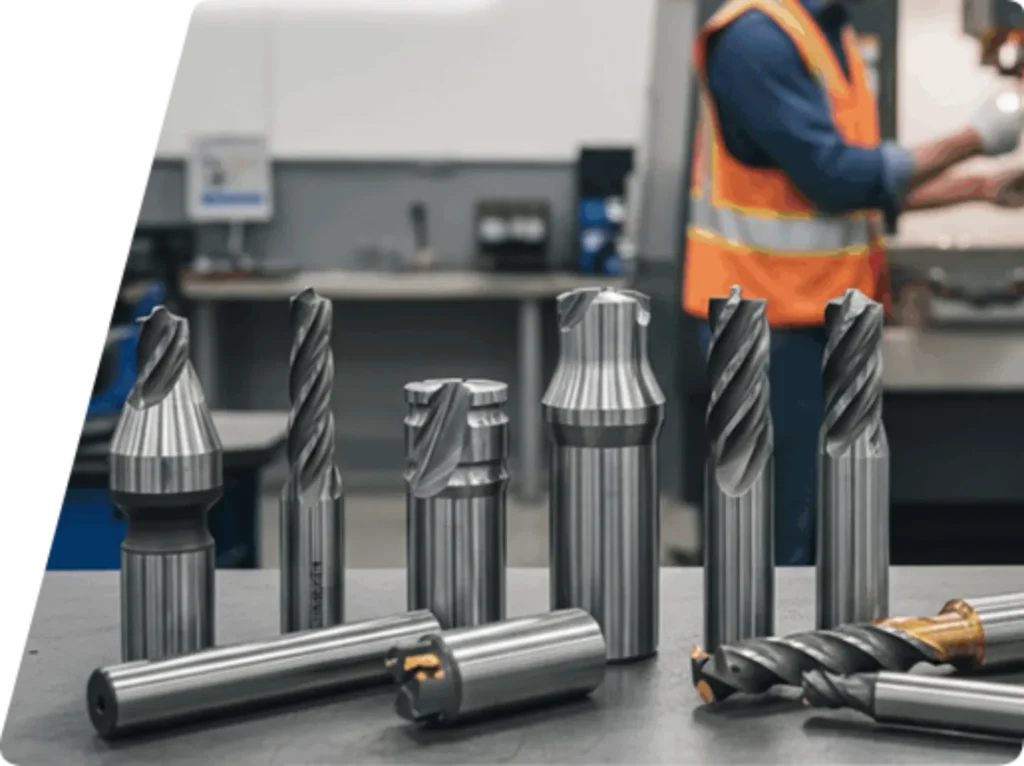
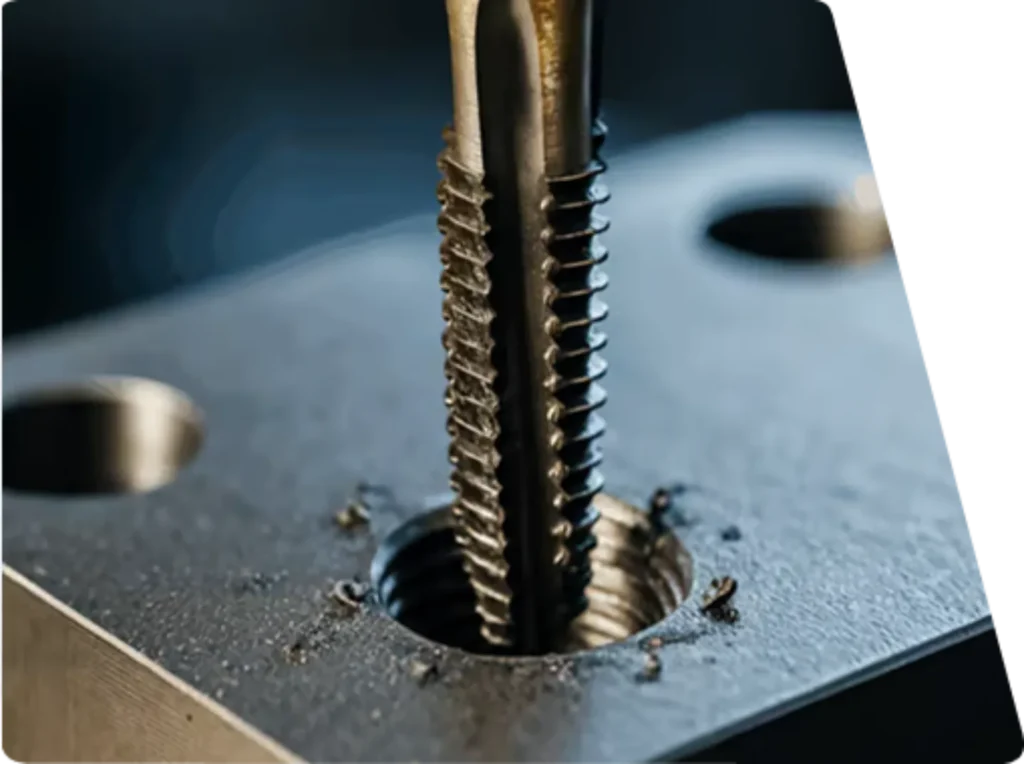
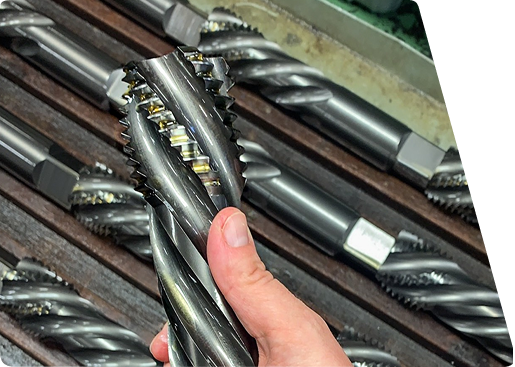
Our innovative designs are used for a wide variety of applications including engine components, fasteners, spin-on oil filters, sucker rod couplings, and in-die tapping. They are produced with ground radius crests designed to reduce torque requirements by as much as 50%.
Our products are manufactured with the crest location in the cutdown section in perfect lead with the crest location in the full diameter. This feature displaces material evenly resulting in reduced torque requirements.
Jarvis can optimize Jarflo designs utilizing variations in the number of lobes and lube grooves, variable cutdown lengths, and controlled minor diameters to maximize productivity and provide the lowest cost-per-hole.
The difference between form taps and cutting taps is important to note out of the gate. Forming taps displace the metal/material, while cutting taps on the other hand remove the material. At Jarvis Cutting Tools we’ve named our line of forming taps the Jarflo series. Learn more about form tapping with our free booklet below!
Learn more about form tapping with our free booklet below!
From leveling fixtures, to cover, to assembly brackets, they all have tapped holes that need a cost effective solution. Jarvis provide industry leading cost-per-hole solutions for a wide variety of industrial customers.
And, Jarvis knows automotive. From fasteners to seat components, we have experience in all different parts and materials.
If you need In-Die Taps, Jarvis Cutting Tools is your manufacturer for in-die tapping!
Want More?
Check out our In-Die tapping partnership with Pronic
You will not find any forming taps (Jarflo’s) that work as well as ours! Jarvis Cutting Tools has the ability to grind either a crest flat or a crest radius. Traditionally, taps are produced with crest flats. This truncated thread form works the best in some applications. But Jarvis ground crest radius has significant advantage in a wide variety of applications. The crest radius provides an edge prep for forming taps. Our rounded shoulders can dramatically increase tap life and create much stronger threads. In fact, there are many applications, which now specify Jarvis’ crest radius because of the extra strength they provide.
Some of the benefits of form tapping include:
Stronger taps
The absence of cutting material due to the use of forming taps eliminates chip residue. Thus, the absence of chips eliminates the need for flutes, resulting in a solid, stronger tap for your application.
Chipless Tapping
Since the thread is formed and not cut, there are no chips to interfere with the tapping process or to cause chip-removal problems in blind holes. This enables cleaner holes with improved surface finish.
Better thread gaging
Forming taps rearranges the metal in the hole to create the thread. Because no metal is cut away, the possibility of producing oversized threads is greatly reduced.
Stronger threads
The grain flow of formed threads – as a result of form tapping – follows the contour of the thread resulting in greater thread strength.
Longer tap life
Jarvis’ industry-leading forming taps last 3 to 20 times longer than cutting taps because they have no cutting edge to dull. This leads to cost savings and greater returns, which in the end equals a stronger hold and a bolstered bottom line. Both are sound business practices.
Jarflo is the premier name in roll form tapping. Our innovative designs are used for a wide variety if applications including:
Jarflo forming taps are produced with ground radius crests designed to reduce torque requirements by as much as 50%. They are also manufactured with the crest location in the cutdown section in perfect lead with the crest location in the full diameter. This feature displaces material evenly resulting in reduced torque requirements.
Jarvis can optimize Jarflo forming tap designs utilizing variations in the number of lobes and lube grooves, variable cutdown lengths, and controlled minor diameters to maximize productivity and provide the lowest cost-per-hole. In fact, according to the most recent 2017 USCTI Data, over 25% of the US Market uses our form taps for their applications.
Our customers need a competitive advantage, and gaining an advantage in this competitive industry is not easy. This requires work, discipline, and more work. It requires both you (aka the customer) and us (aka the supplier) to define the objective, test the options, measure the results, and implement the solution. Standard catalog items can take you only part of the way; why not experience an exclusive solution?
With that in mind, Jarvis’ exclusive tooling solutions have been continuously proven to reach far beyond the performance of the tools you are using now. Contact us today to set up a free consultation and (if applicable) trial period to help cultivate the exact tool you need to achieve a competitive advantage. Who can’t benefit from that?
We’re Here For Whatever You Need
Customer support, engineering support, or general inquires.
A form tap, also known as a roll tap or fluteless tap, is a tool used to create threads by displacing material rather than cutting it. It doesn’t remove metal but forms threads by pushing material into shape. This produces stronger threads and avoids chip clogging.
What are the three forms of tap?
Taps are generally categorized into three types:
Cutting Taps – Remove material to create threads
Forming Taps – Displace material to form threads
Pipe Taps – Designed for threading pipes and fittings
What materials can be form tapped?
Form tapping works best on ductile metals like aluminium, brass, copper, stainless steel, and low-carbon steels. It can also work on materials like Inconel. It is not suitable for brittle materials like cast iron, as they may crack.
What is the purpose of a thread tap?
A thread tap is used to create internal threads in a hole so that a bolt or screw can be inserted, ensuring a secure and precise fit.
Can you use a form tap by hand?
Not really. Form taps require consistent pressure and torque, which are difficult to achieve manually. They work best with machines like CNC or drill presses.
What are form taps used for?
Form taps are commonly used in high-volume production, especially with soft, ductile metals. They are ideal for producing strong, burr-free threads without chip issues.
What is the thread percentage of a form tap?
Form taps typically produce threads with a 70–75% thread percentage, depending on drill size. Although slightly lower than cutting taps, the threads are stronger due to work hardening.
What are your Hours of Operation?
We are open 5 days per week, with 3 shifts running.
Office Hours:
Mon: 7:30 AM – 5:00 PM
Tue: 7:30 AM – 5:00 PM
Wed: 7:30 AM – 5:00 PM
Thu: 7:30 AM – 5:00 PM
Fri: 7:30 AM – 5:00 PM (Summer hours until 2:00 PM)
OUR BLOGS
What’s Next?
Since our inception in 1901, Jarvis Cutting Tools has been and continues to be a family-owned business manufacturing.