Walk into almost any shop, and you’ll notice that aluminum gets treated as an easy job. You hand it to the new guy. Soft metal, sharp bit, done by lunch.
Then the parts come back wrong. Holes that miked a couple thou oversize. A gummy ring of metal smeared around a bit that had been drilled fine an hour earlier. Somebody blames the operator, drops in a fresh drill, and the same thing shows up again before the shift ends.
That repeat is the tell. The operator usually isn’t the problem, and neither is the machine. It is the drill being wrong for what aluminum actually does under a cutting edge. Aluminum is soft, yes. It is also sticky, abrasive once you get into the cast grades, and quick to grab a tool ground for steel.
Picking the best drill bits for aluminum comes down to a few things most roundup articles gloss over: what the bit is made of, how it is ground, what coating sits on it, and how you run it. Get those wrong, and you make scrap. Get them right, and the holes just come out clean.
Everything to Know About Aluminum in Machining
Before you pick a tool, it helps to understand why aluminum behaves the way it does. The metal’s reputation for being soft hides the real story.
How Aluminum Behaves as a Drilling Material
Aluminum has a low shear point. The cutting edge slices the material rather than plowing it aside, the way it would in harder steel. That sounds like an advantage, and at the right speed, it is.
The catch is ductility. Aluminum stretches before it breaks, so chips come off long and stringy instead of breaking into chips you can flush. Those chips pack into the flutes if they have nowhere to go.
Then there is heat. Aluminum conducts heat well and melts around 1,220 degrees Fahrenheit, which is low for a structural metal. A dull edge or a clogged flute builds friction fast, and the chip starts to soften and stick.
One more thing decides how a grade is cut: silicon. Wrought grades like 6061 carry very little. Cast grades carry a lot, and high-silicon castings are abrasive enough to chew through the wrong tool in a single run.
Common Problems When Drilling Aluminum
The most common failure is a built-up edge. Soft aluminum welds itself to the cutting edge under heat and pressure, the welded lump tears away, and it takes a chunk of your finish and edge geometry with it. A study on drilling 6061-T651 found that built-up edge formed most readily on tools whose coating had a chemical attraction to aluminum, which is a clue we come back to later.
Oversized holes are the second complaint. The same study reported every hole running oversize regardless of the tool, which tells you that aluminum’s springback and the drill’s own runout both push the final size up. A 0.250 drill rarely gives you a 0.250 hole.
Chip welding and poor finish come next, usually from chips that never left the hole. Long chips recut, screech, and leave a torn wall. Burrs on the exit side round out the list, because soft material folds over instead of shearing clean at breakthrough.
Types of Drill Bits for Aluminum
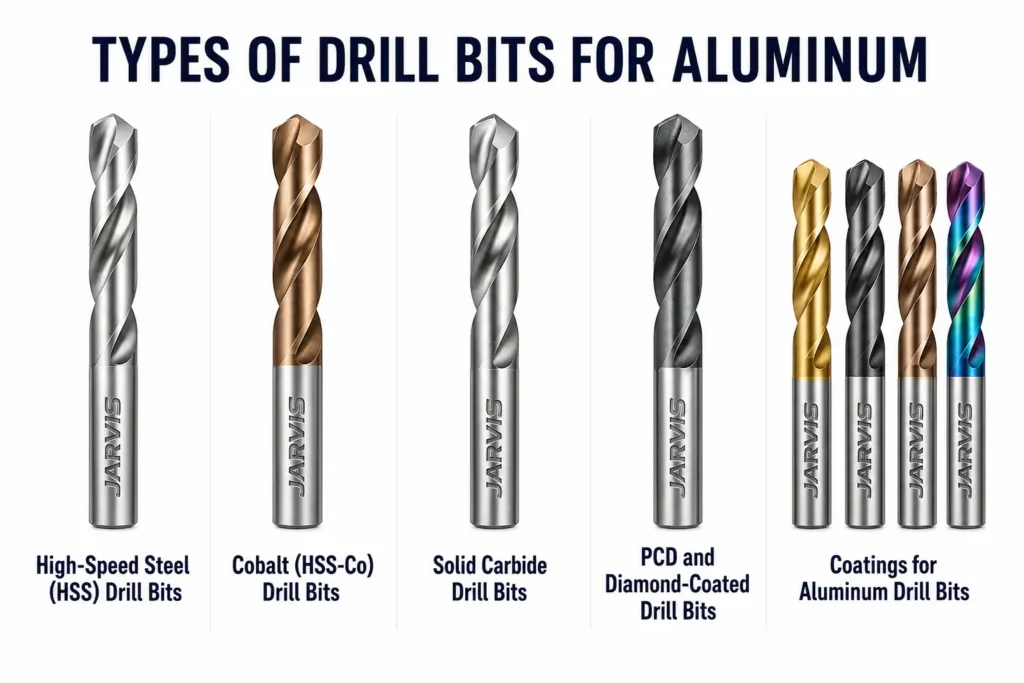
When people ask what kind of drill bit for aluminum holds up in production, the honest answer is that it depends on the alloy and the volume. There are four substrates worth knowing, plus the coating question that sits on top of all of them. These are the drill bits for aluminum you will actually reach for.
High-Speed Steel (HSS) Drill Bits
HSS is the baseline. It is tough, cheap, and forgiving, which is why it lives in every drill index in the building. For low-volume work, maintenance jobs, and manual drilling, it does the job without complaint.
Where HSS struggles is with heat and abrasion. It loses its edge faster than the harder substrates, and the silicon in cast grades wears it down quickly. For occasional holes in 6061, HSS is fine. For a production cell running thousands of holes, it becomes the bottleneck.
Cobalt (HSS-Co) Drill Bits
Cobalt bits are HSS with cobalt blended into the steel, usually 5 to 8 percent. The cobalt raises heat resistance, so the edge holds longer when the cut runs hot. Grades like M35 and M42 are the common ones.
For tougher wrought grades and shops that also drill stainless on the same tools, cobalt is a sensible middle ground. It costs more than plain HSS and less than carbide. It will not match carbide for finish or tool life in aluminum, but it tolerates abuse better than a standard jobber bit.
Solid Carbide Drill Bits
Solid carbide is the production default for aluminum. It is far harder than HSS, holds a sharp edge several times longer, and runs at much higher surface speeds. In a CNC running flood coolant, a good carbide drill will outlast a stack of HSS bits and hold size better doing it.
The trade is its rigidity. Carbide is hard but brittle, so it wants a stable setup, tight runout, and no hand feeding. Drop a carbide drill or run it in a sloppy holder, and it chips. For anyone weighing the long-term math, it is worth knowing about the advantages of using carbide tools in abrasive work before deciding on cost alone.
PCD and Diamond-Coated Drill Bits
Polycrystalline diamond sits at the top for abrasive aluminum and high volume. Nothing else survives high-silicon cast alloys like A390 the way diamond does. The edge resists the abrasive silicon particles that destroy carbide.
PCD is expensive, and it does not like heavy interrupted cuts that shock the edge. You buy it when the part justifies it: long runs, abrasive castings, or finish requirements that a worn tool cannot hold. In those jobs, the cost per hole drops even though the tool is pricey, because it simply keeps cutting.
Coatings for Aluminum Drill Bits
Coatings on aluminum are where shops go wrong most often. The instinct is that more coating means more performance, and for aluminum, that instinct backfires.
A bright, polished, uncoated carbide edge is often the best edge for aluminum. It is sharper and slicker, and a slick flute sheds chips instead of letting them stick. DLC, or diamond-like carbon, takes that further. One tooling study on DLC for aluminum measured a large drop in thrust force and less adhesion, which means cleaner holes and less deburring.
The coating to avoid is the one with aluminum already in it. TiAlN and AlTiN are excellent on steel, but the aluminum content in the coating has a chemical affinity for aluminum workpieces and tends to gall and weld. TiN and ZrN are safer choices when you want a coating. If you want the full picture on how coatings change tool behavior, it is worth reading before you spec a finish.
Here is how the four substrates stack up for aluminum work. Treat the speeds as starting ranges, not gospel, because alloy, coolant, and rigidity all move the numbers
| Feature | HSS | Cobalt (HSS-Co) | Solid Carbide | PCD |
| Relative Hardness | Lowest | Low-to-medium | High | Highest |
| Tool Life in Aluminum | Short | Moderate | Long | Longest |
| Typical Speed | 100 to 200 SFM | 150 to 250 SFM | 300 to 500+ SFM | Below 1,000 SFM on high-Si |
| Best Alloy Fit | Soft wrought (6061, 1100) | Tougher wrought (7075, 2024) | Most wrought and cast | High-silicon cast (A390) |
| Relative Cost | Lowest | Low-to-medium | Medium-to-high | Highest |
| Ideal Use | Manual, maintenance, and low-volume work | Mix shops and light production | CNC production with tight tolerances | High-volume work and abrasive castings |
Drill Bit Sizes That Work Well With Aluminum
Picking the right diameter is half the job. The other half is knowing how aluminum changes in size after the drill passes through.
Standard Sizing Systems (Fractional, Number, Letter, Metric)
Four systems cover almost everything you will drill. Fractional runs from 1/16 inch up through the common shop sizes in 1/64 steps. Number sizes (1 through 80) and letter sizes (A through Z) fill the gaps between fractions, which matters for tap drills and dowel pins. Metric covers the rest.
For aluminum, the system is less important than having the in-between sizes on hand. A hole that needs a #7 drill will not be right if you force a 13/64 because that is what was in the index.
Sizing for Tolerance and Springback in Aluminum
Aluminum does not hold the drill’s diameter exactly. The hole usually finishes slightly oversize because of drill runout, a touch of built-up edge, and the way soft walls relax after the cut. The amount varies with the grade and the tool.
When the print calls for a tight, round, located hole, do not chase it with a drill. Drill undersized by a few thousandths and ream or bore to size. Reaming removes the variation the drill leaves behind. This is also where setup matters, because tool deflection pushes a hole off size and off position before the operator ever sees a measurement.
Tap Drill Sizes for Threaded Holes in Aluminum
If the hole gets threaded, the drill size depends on whether you cut or form the thread. Cut taps want the standard tap drill from the chart, sized for roughly 75% thread engagement. A 1/4-20 cut thread, for example, takes a #7 drill at 0.201 inch.
Form taps are different. They push the material rather than cutting it, so the starting hole is larger than a cut-tap hole for the same thread. Use the wrong chart, and you either snap the tap or strip the thread. Aluminum’s ductility makes it a strong candidate for form tapping, so the distinction comes up often.
How to Choose the Best Drill Bits for Aluminum
With the substrates and sizes covered, the choice comes down to matching the tool to the job. The best drill bits for aluminum on paper still fail if they are wrong for the alloy in the vise. Five factors decide it.
Match the Bit to Your Aluminum Alloy
The grade drives everything. 6061 machines cleanly and tolerates a wide speed window, so HSS or carbide both work depending on volume. 7075 and 2024 are harder and stronger, so drop the speed slightly and lean toward cobalt or carbide.
5052 is the troublemaker. It is soft and sticky, and it clings to the edge worse than 6061, so it wants a sharper tool, lower RPM, and good coolant. Cast grades depend on silicon content. Ordinary castings cut fine with carbide, while high-silicon alloys like A390 are abrasive enough to demand PCD.
Choose Geometry for Chip Control
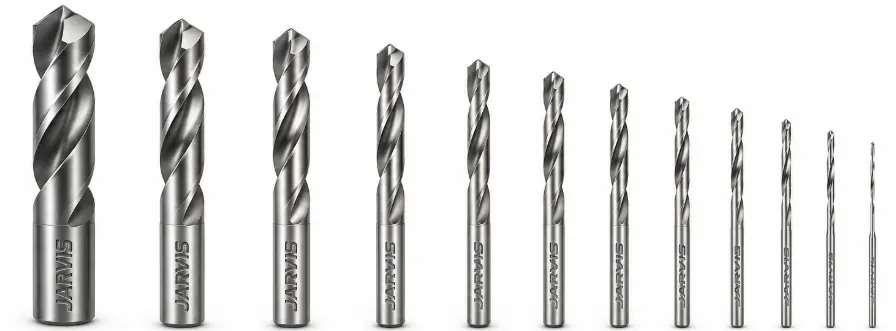
Geometry is what separates a tool that clears chips from one that packs them. For aluminum, you want a high helix angle, in the range of 35 to 40 degrees or higher, because the steeper spiral acts like an auger and throws long chips out of the hole.
Point angle matters too. A point angle around 130 to 140 degrees with polished flutes gives the best chip evacuation, because aluminum’s low shear point responds to an upright, sharp edge. Polished flutes are not cosmetic. A smooth flute gives sticky aluminum nothing to grab.
Pick the Right Coating, or None at All
Default to a bright, polished edge for aluminum. Add DLC when you are running high volume and want to cut deburring and thrust. Reach for TiN or ZrN if you want some wear protection without the galling problem. Skip TiAlN and AlTiN. The aluminum in those coatings is the same metal you are trying to keep off the tool.
Factor in Hole Depth and Diameter
Depth changes the tool. A shallow hole forgives a lot. Once the hole gets past three or four times the drill diameter, chip evacuation becomes the whole game, and a higher helix plus a peck cycle keeps the flutes clear. Large diameters raise thrust and torque, so the setup needs more rigidity, and the feed needs more control.
Weigh Tool Life Against Cost per Hole
Purchase price is the wrong number to optimize. A carbide drill costs more than HSS, but if it drills ten times the holes between changes and holds size the whole way, the cost per hole drops. The best aluminum drill bits for a given job are the ones that lower your total cost across the run, not the cheapest box on the shelf. Count tool changes, scrap, and downtime, then decide.
How to Drill Aluminum Properly
The right bit still fails with the wrong technique. Drilling aluminum well is mostly about speed, chip control, and keeping the cut cool.
Set Spindle Speed for Your Alloy
Surface speed drives the rest. HSS in aluminum runs roughly 100 to 200 SFM, while carbide handles 300 to 500 SFM and often much more in a rigid machine. Wrought grades tolerate higher surface footage than cast grades, which run slower. Convert to RPM with the drill diameter, and you have a starting point.
Control the Feed Rate
Feed controls chip thickness, and chip thickness controls heat. Feed too light and the bit rubs, builds heat, and welds aluminum to the edge. Feed too hard, and you overload the flutes. A feed near 0.002 to 0.005 inch per revolution suits common small-diameter holes in 6061. Watch the chip. A clean C-shaped chip means you are close.
Peck Drill Deep Holes
Once the hole passes about three times the drill diameter, peck, a full-retract peck cycle pulls the drill clear out of the hole so chips clear and coolant gets back in. A high-speed peck only backs off slightly to break the chip, which suits moderate depths. Deep holes in aluminum fail from packed flutes more than anything else, so when in doubt, peck.
Flood the Cut With Coolant
Coolant does two jobs in aluminum: it carries heat away and flushes chips out. Flood coolant is the standard for production drilling because it does both at once. Some shops run dry with an air blast and a sharp, uncoated carbide tool at high speed, which works, but it leaves less margin for error. Either way, the enemy is a hot, dry chip sitting in the flute.
Lock Down Workholding
A drill is only as accurate as the part and the holder around it. A part that shifts under thrust gives you an oversized or angled hole. The same goes for the tool end, where the chuck you hold the drill in decides whether the bit runs true or walks. Tight runout at both ends keeps the hole round and on location.
Spot or Center Before Drilling
Drills wander when they touch a flat face, especially a standard 118-degree point. A spot or center drill gives the bit a cone to start in, so it bites where you want it. A 135-degree split point self-centers better and often skips the spot on flat 6061, but anything large or anything on a curved surface earns a spot first.
Deburr and Inspect the Hole
Aluminum folds at the breakthrough, so the exit side throws a burr almost every time. Ease the feed near the breakthrough to keep the burr small, then deburr with a back chamfer tool or a hand pass. Inspect for size and finish before the part moves on. If you are threading next, a clean, correctly sized hole is the whole foundation, which is why it pays to plan drilling and tapping aluminum together rather than treating them as separate jobs.
Conclusion
Aluminum punishes the assumption that soft means easy. The metal sticks, springs back, and grabs, and the drill you choose decides whether those tendencies show up in your parts. The best drill bits for aluminum are not a single product. Substrate sets the ceiling on tool life, geometry controls the chips, coating either helps or galls, and technique ties it all together.
Pick the tool for the alloy in front of you, run it at the right speed with the chips clearing, and the holes stop being a fight. That is the whole point of choosing the right tool: fewer surprises at inspection and a process you can trust to repeat. If you are weighing tooling for a demanding aluminum job and want a tool matched to the alloy and volume, get in touch with us at Jarvis Cutting Tools, and our engineering team will be glad to talk it through.
Frequently Asked Questions (FAQs)
Can you use a regular twist drill bit for aluminum?
Yes, for light, low-volume work. A standard HSS twist drill cuts aluminum, but it walks, loads up, and dulls faster than a purpose-ground bit. Keep it sharp, slow the feed, and add lubricant.
Do you need a pilot hole when drilling aluminum?
Not always. A 135-degree split point self-centers and skips the pilot on most flat wrought grades. For large diameters, curved surfaces, or 118-degree bits, spot drill first so the tool does not wander.
Can one drill bit handle both aluminum and steel?
A cobalt or general-purpose HSS bit cuts both, but neither runs ideally. Aluminum wants a high helix and polish, while steel wants a tougher coating. Compromise tools wear unevenly and rarely hold tolerance in either material.
Why does the bit grab as it breaks through aluminum?
The thin wall left at the breakthrough flexes, then the drill’s sharp geometry pulls itself into the soft metal. Ease the feed near the bottom, back the part with a sacrificial plate, or use a lower helix.
Is WD-40 good enough for drilling aluminum?
For occasional manual or maintenance drilling, yes. It keeps chips from welding and improves the finish. For any production work, use a proper soluble coolant or cutting oil, which cools the cut and flushes chips far better.
Does aluminum dull drill bits quickly?
Wrought grades are gentle on edges. Cast and high-silicon alloys are abrasive and wear bits fast, because silicon particles act like grit. That abrasion is exactly why carbide or PCD lasts longest in those materials.