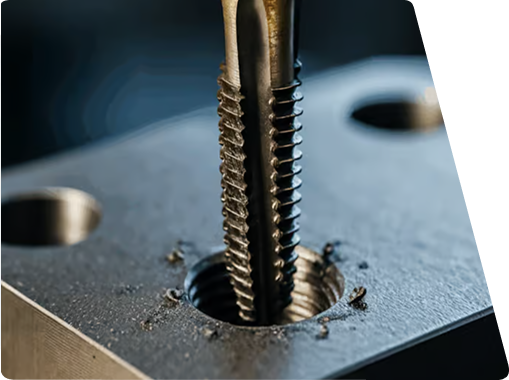
From NPT to BSP, Jarvis manufactures application-specific cutting and roll-forming pipe taps using advanced materials, coatings, and processes to keep you ahead of industry demands.
Jarvis Cutting Tools manufactures pipe taps to the full range of North American and international pipe thread standards: NPT, NPTF, NPS, NPSF, BSP, or BSPT. Whether you’re threading gray, cast-iron valve bodies, 316 stainless hydraulic fittings, or aluminum die-cast housings, we’re your go-to pipe tap manufacturers.
We build all taps to fit the material, the thread form, and your throughput requirements. That means the right substrate (standard HSS for most ferrous and non-ferrous applications, HSS-E cobalt for stainless and work-hardening alloys) and the right coating for the cutting conditions: oxide for general work, and TiN, TiCN, or other application specific coatings where surface hardness and tool life are the priority.
We’re also directly involved in PM steel testing and coating evaluation, working with new materials and surface treatments before most of the market sees them.
Every pipe threading tap we produce is held to the dimensional standards that you want: correct taper per foot, consistent pitch diameter, and thread form that mates perfectly in the first try.
Our tools are built to your actual process conditions, and not averaged across a catalog range. If you need any application-specific guidance or a made-to-order special, our engineering team is an email away.
Pipe Taps & Thread Applications & Materials Jarvis Is Tapping
A105
Brass
Cast Bronze
Copper
Aluminum Die Cast
Carbon Steel
Connecting Rods
Couplings
Drops
Engine Blocks
Gray Cast Iron
Locomotive Engines
Elbows
Gas Fittings
Hydraulic Fittings
Malleable Iron
Reducers
Steel Forgings
Tees
Unions
Utility Controls
Valves
304 & 316 SS
Offerings
Our Complete Range of Pipe Taps
At Jarvis, pipe taps are manufactured in high-speed steel to ASME B1.20.1 (NPT) and ASME B1.20.3 (NPTF) specifications, with straight pipe taps built to NPS standards. Don’t confuse one type with the other.
NPT (National Pipe Taper): Tapered thread form; seals with sealant assist under standard pressure conditions.
NPTF (Dryseal): Tighter tolerances than NPT; metal-to-metal contact seals without sealant or compound.
NPS (National Pipe Straight): Straight thread for gasket-sealed joints; not designed to hold pressure alone.
NPSF (National Pipe Straight – Dryseal): Straight thread for gasket-sealed joints; metal-to-metal contact seals without sealant or compound.
Interrupted Thread: Alternating threads removed for chip clearance; best suited for soft ductile materials.
Short Projections: Shallow hole applications requiring the projection to be achieved in a shorter distance.
Long Taper / Extended Length: Standard NPT taper geometry on a longer shank for deep-reach applications.
BSPT (British Standard Pipe Taper): 55° Whitworth taper thread; international standard, not interchangeable with NPT tooling.
BSPP (British Standard Pipe Parallel): Straight BSP thread sealing via bonded seal; common in European hydraulic systems.
0+
Products Categories
0k
Products Delivered
0%
Certified Partners
0%
Client Satisfaction
Scope
Powering Industries with Our Pipe Taps
Run the wrong pipe tap into a fitting, and you’ll see that either the thread doesn’t seal, the mating part doesn’t engage, or you’re stuck chasing a leak in a pressurized assembly that shouldn’t have been there. The thread standards each application calls for are determined by the material, pressure rating, industry spec, and whether the joint seals on thread form or on a gasket.
Jarvis manufactures pipe thread taps for the full range of industrial applications.
Oil and Gas: Valve bodies, wellhead fittings, and distribution controls threaded to NPT and NPTF standards.
Hydraulics and Pneumatics: Manifolds, cylinders, and fluid line fittings in industrial and mobile hydraulic systems.
Mold Manufacturing: Extended length taps for the side port valves. Standard NPT taps for the other connections.
Automotive and Engines: Oil galleries, coolant passages, and fuel system fittings in cast iron and aluminum engine blocks.
Plumbing and Water Systems: Municipal and commercial piping assemblies, valves, couplings, and reducers in malleable iron, brass, and copper.
Heavy Equipment and Mining: Hydraulic and pneumatic fittings on equipment that runs hard in demanding conditions.
Locomotive and Rail: Pipe threaded connections in locomotive engines and associated fluid systems.
Electrical and Conduit: NPS straight pipe taps for conduit fittings, junction boxes, and electrical enclosures.
Industrial Manufacturing and Machine Building: Pipe tapped ports in machine frames, tooling fixtures, and fluid delivery systems.
Aerospace and Defense: Precision pipe threaded connections in fluid and pneumatic systems where dimensional consistency and material traceability matter.
Utilities and Gas Distribution: Gas valves, regulators, and service fittings threaded in malleable iron and cast steel.
The different types of pipe taps include NPT, NPTF, NPS, interrupted thread, long taper, BSPT, and BSPP. Each one of them serves a distinct thread standard and sealing method. The wrong selection produces threads that won’t seal ot mate correctly.
What are the different pipe tap sizes?
Standard NPT pipe tap sizes run from ⅛” through 6”, pitch ranging from 27 TPI at ⅛” down to 8 TPI at 2” and above. BSP follows a different pitch series. Always confirm the thread standard before selecting a size.
What’s the difference between BSP and NPT pipe taps?
NPT uses a 60° thread form, while BSP uses 55°. The two are incompatible: same nominal size, but different pitch and angle. If your spec references ISO 228 or BS 21, confirm that your pipe taps supplier is quoting BSP tooling, and not NPT.
What is the difference between pipe threading taps and standard taps?
Standard taps cut unified or metric thread forms for fastener engagement. Pipe threading tapes cut tapered or straight forms to different standards, designed for fluid sealing and pressure connections, not bolt-thread profiles. Both kinds of taps have different geometries and serve different purposes entirely.
How to extend the tool life of pipe taps?
Most common pipe tap failures can be traced back to three things: wrong substrate for the material, insufficient lubrication, or running too fast for the thread form. The best way to prevent these failures and extend tool life is to match the substrate and coating to your workpiece, use cutting fluid suited to the material, and verify your tapping speed before running production.
How to identify if a pipe tap is worn and needs replacing?
Some indicators of the deteriorating condition of pipe taps are torn thread flanks, oversized pitch diameter on gauged threads, increased torque during the cut, and visible wear on the chamfer threads. In all of these cases, it’s best to replace the tap before it leads to thread damage in the workpiece.
What materials do Jarvis’s pipe taps work with?
As a dedicated pipe threading taps supplier company, we at Jarvis cover gray cast iron, malleable iron, carbon steel, 304/316 stainless, brass, copper, cast bronze, and aluminum die cast. Geometry and coating vary by material. You can contact our highly qualified team of engineers for a specific recommendation.
Can Jarvis produce non-standard or special pipe thread taps?
As one of the top pipe tap manufacturers, Jarvis builds a standard catalog as well as makes-to-order specials for non-standard thread forms, extended lengths, non-catalog substrates, and specific coatings. If your application falls outside of the standard catalog specs, contact our team with your requirements to get a custom quote.
Need a Pipe Tap Manufacturer That
Works According to Your Application?
Reach out to discuss your thread standard, material, and volume, and we’ll take it from there.